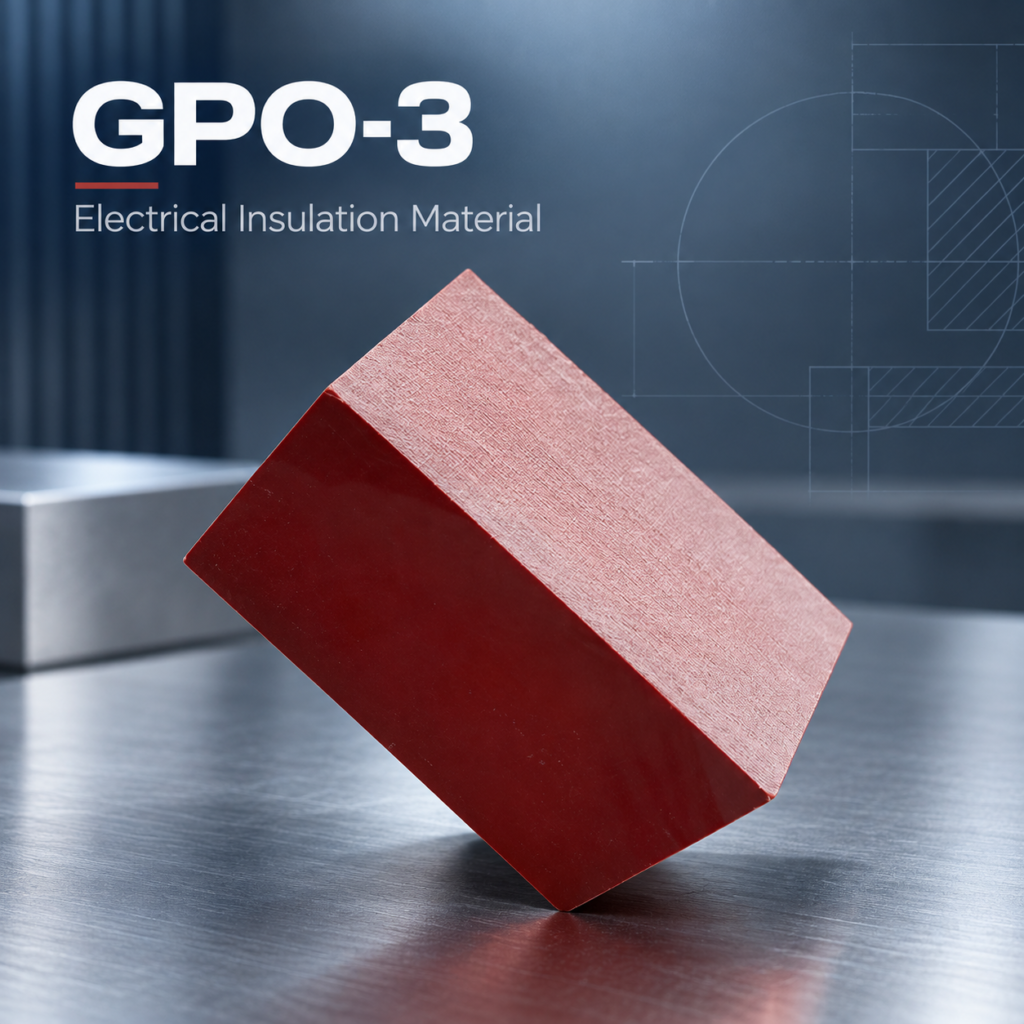
Finding a reliable NEMA GPO-3 sheet supplier can be challenging for U.S. electrical equipment manufacturers. Material designation alone does not guarantee consistent dielectric performance, flame resistance, dimensional accuracy, or production quality. As a GPO-3 manufacturer serving the U.S. market, SUSDURA focuses on supplying NEMA GPO-3 insulation sheets and customized electrical insulation components, helping OEM engineers and procurement teams evaluate material compliance, technical requirements, and long-term supply reliability.
TL;DR — What U.S. Buyers Need to Know
Material designation: NEMA GPO-3 is a glass-mat-reinforced, unsaturated polyester thermoset laminate widely used in industrial electrical insulation.
Standards: GPO-3 is a material grade within the NEMA LI 1 system, while UP GM 203 is a commonly corresponding designation within IEC 60893.
Key properties: Electrical insulation, mechanical strength, flame resistance, tracking resistance, and dimensional stability are critical selection factors.
Product options: Buyers may require full-size GPO-3 sheets, cut-to-size panels, or custom CNC-machined electrical insulation components.
U.S. sourcing: SUSDURA supports technical material selection, customized manufacturing requirements, quality documentation, and international procurement.
1. NEMA GPO-3 Standards for the U.S. Electrical Insulation Market
In the United States, material standards play an essential role in the purchasing and approval process for electrical insulation components. Engineers frequently specify materials using established designations to reduce uncertainty when selecting insulation for switchgear, transformers, and power distribution equipment.
NEMA GPO-3 is a thermosetting polyester glass-mat laminate recognized within the NEMA LI 1 classification system. The material is produced by combining unsaturated polyester resin with glass-mat reinforcement under controlled heat and pressure to form a rigid electrical insulation sheet.
This combination provides several functional advantages:
Electrical insulation for separating conductive components.
Mechanical rigidity for structural insulation applications.
Flame-retardant performance for suitably formulated grades.
Resistance to electrical tracking under specified conditions.
Dimensional stability and machinability for fabricated insulation parts.
NEMA GPO-3 vs. IEC UP GM 203
American and international buyers may encounter different material designations for comparable polyester-glass laminates.
Classification | Material designation | Market relevance |
|---|---|---|
NEMA LI 1 | GPO-3 | Common in U.S. electrical engineering specifications |
IEC 60893-3-5 | UP GM 203 | International electrical insulation classification |
EN 60893 | UP GM 203 | Common in European technical documentation |
DIN 7735 | HM 2471 | Legacy designation appearing in some European specifications |
Although GPO-3 and UP GM 203 are commonly cross-referenced, material equivalence must be established through the actual product specification and test results rather than designation alone.
For U.S. procurement teams, this distinction is particularly important when qualifying an alternative overseas supplier.
SUSDURA can support material specification reviews based on customers’ NEMA GPO-3 requirements, including electrical, mechanical, dimensional, and fire-performance criteria.
Important compliance distinction: NEMA publishes standards but does not itself certify products. A supplier’s statement of conformity should therefore identify its supporting test reports and any applicable third-party certification.
Authoritative standard references:
Key Takeaways
NEMA GPO-3 is a recognized material grade for industrial electrical insulation.
UP GM 203 is a commonly corresponding international material designation, subject to performance verification.
Technical compliance must be supported by appropriate documentation.
Internal Link Suggestion: Explore SUSDURA GPO-3 Material Specifications and Technical Data.
2. SUSDURA GPO-3 Material Properties, Electrical Performance & Quality Control
For U.S. electrical equipment manufacturers, selecting a GPO-3 insulation board involves more than checking material color, thickness, or price.
Electrical insulation components must operate reliably under mechanical loading, electrical stress, temperature fluctuations, and environmental exposure. Therefore, evaluating the actual GPO-3 material properties is an essential step before approving production materials.
Critical Properties for Electrical Applications
Property | Engineering significance | Suggested verification |
|---|---|---|
Dielectric strength | Resistance to electrical breakdown | IEC 60243-1 or specified equivalent |
CTI | Resistance to electrical tracking | IEC 60112 |
Insulation resistance | Electrical isolation performance | Applicable test method and conditioning |
Flame resistance | Material response to ignition | UL 94 |
Flexural strength | Resistance to bending loads | ISO 178 or ASTM D790 |
Tensile strength | Structural loading capability | ISO 527 or ASTM D638 |
Heat resistance | Performance at elevated temperatures | Defined thermal test or rating |
Water absorption | Moisture sensitivity | ISO 62 or ASTM D570 |
Thickness tolerance | Assembly compatibility | Agreed dimensional specification |
Understanding GPO-3 UL 94 V-0 Requirements
A common requirement among U.S. electrical manufacturers is GPO-3 UL 94 V-0 flame resistance.
UL 94 V-0 is a flammability classification assessed under defined laboratory conditions. It should not be interpreted as proof of noncombustibility or an automatic indication of UL product recognition.
For purchasing purposes, buyers should confirm whether a material’s V-0 classification applies to the specified thickness and whether the supplier holds applicable third-party recognition.
Material Qualification and Traceability
For SUSDURA, effective material qualification should connect formulation control, manufacturing consistency, finished-sheet inspection, and technical documentation.
Depending on customer requirements, the evaluation package can include a Technical Data Sheet, applicable laboratory test reports, dimensional inspection results, and batch identification records.
These documents help engineering teams assess whether material properties remain consistent between prototype evaluation and repeat production orders.
Key Takeaways
Dielectric performance, flame resistance, and mechanical strength must be evaluated together.
UL 94 V-0 ratings and UL Recognition are different forms of evidence.
Documented quality control supports repeatable manufacturing and supplier qualification.
Internal Link Suggestion: Learn More About Electrical Insulation Material Testing and Quality Control.
3. GPO-3 Sheets, Cut-to-Size Panels & Custom CNC Machined Components
Different U.S. customers require different forms of GPO-3 materials. A raw-material distributor may purchase full-size sheets, while a switchgear manufacturer may require precision-machined insulation barriers ready for assembly.
As a potential long-term GPO-3 sheet supplier, SUSDURA aims to support both standardized material procurement and custom component development.
Standard GPO-3 Insulation Sheets
A GPO-3 polyester glass laminate is typically supplied in rigid sheet form for subsequent cutting, machining, or installation.
When specifying a sheet, buyers should define the nominal thickness, length, width, color, thickness tolerance, flatness requirements, and applicable material grade.
American customers often use imperial dimensions, including 1/8 inch, 1/4 inch, 3/8 inch, and 1/2 inch.
The following sizes illustrate common purchasing specifications, not confirmed SUSDURA stock availability.
Nominal U.S. thickness | Metric equivalent | Typical procurement format |
|---|---|---|
1/8 inch | 3.175 mm | Full sheet or cut panel |
1/4 inch | 6.35 mm | Full sheet or fabricated part |
3/8 inch | 9.525 mm | Cut-to-size insulation |
1/2 inch | 12.7 mm | Structural insulation part |
3/4 inch | 19.05 mm | Heavy-duty insulation component |
1 inch | 25.4 mm | Thick-section structural component |
Actual supplied thicknesses, tolerances, and availability should be confirmed during quotation.
Custom GPO-3 CNC Machined Parts
For more specialized projects, GPO-3 CNC machined parts can be produced according to engineering drawings.
Typical fabrication operations include precision cutting, drilling, milling, slotting, edge finishing, and customized hole patterns.
These processes are particularly useful when producing custom GPO-3 insulation parts with complex assembly interfaces or tight dimensional requirements.
For effective machining, manufacturers must also consider laminate direction, edge integrity, tooling selection, and the possibility of fiber exposure or local delamination.
A clear machining specification should therefore include finished dimensions, tolerances, critical features, inspection requirements, and acceptable edge conditions.
Key Takeaways
U.S. buyers frequently specify material thickness in inches.
Full sheets and machined components require different procurement and inspection procedures.
Accurate drawings and tolerances are essential for custom GPO-3 manufacturing.
4. GPO-3 Electrical Insulation Applications in U.S. Power Equipment
GPO-3 electrical insulation materials are widely associated with power distribution and industrial electrical equipment because they combine electrical isolation with structural reinforcement.
However, the suitability of a GPO-3 component depends on the actual electrical design, environmental conditions, mechanical loads, and safety requirements.
Switchgear Insulation Barriers
One major application is GPO-3 switchgear insulation, where rigid sheets are fabricated into barriers, partitions, and supports within electrical assemblies.
These components help separate conductive elements and maintain the intended insulation geometry.
For switchgear manufacturers, important selection criteria include dielectric strength, flame resistance, mechanical rigidity, cut-edge quality, and dimensional stability.
Electrical clearances and creepage distances must be determined by the applicable equipment design standards rather than by material grade alone.
Busbar Supports and Structural Insulation
In industrial power distribution assemblies, GPO-3 busbar supports may be used as structural insulating members, mounting plates, or fabricated support components.
Because busbar assemblies can experience significant electrodynamic forces during short-circuit events, material selection must consider more than dielectric properties.
Designers should assess mechanical loading, bolt-hole stresses, fastening geometry, and the effects of elevated temperature.
Transformer Insulation
GPO-3 transformer insulation components may include terminal boards, insulating spacers, structural panels, and electrical separation elements.
For these applications, operating temperature, moisture exposure, dielectric stress, and long-term mechanical performance must be considered.
The insulation material should be qualified for its intended operating environment, especially when exposed to sustained thermal loading.
Other Industrial Applications
GPO-3 sheets can also support electrical enclosure assemblies, industrial control panels, power conversion systems, and selected energy infrastructure applications.
In each case, component geometry and material characteristics should be evaluated together.
Key Takeaways
GPO-3 serves both electrical and mechanical functions.
Switchgear, busbar, and transformer applications have different design requirements.
Final material approval depends on the complete assembly’s operating conditions.
5. How U.S. OEMs Should Qualify a NEMA GPO-3 Sheet Manufacturer
Selecting a GPO-3 sheet manufacturer is fundamentally a supplier-qualification decision rather than a simple material-price comparison.
Electrical equipment manufacturers frequently work with materials that become part of safety-critical systems. Consequently, purchasing teams need confidence that a supplier can deliver consistent specifications across multiple production batches.
Step 1: Verify Material Designation and Test Evidence
An effective qualification process begins by confirming that the proposed material matches the engineering drawing.
For products specified as NEMA LI 1 GPO-3, buyers should request supporting evidence for the applicable requirements.
If UL Recognition is required, the supplier should provide the appropriate file reference and identify the covered material grade and thickness range.
Step 2: Review Manufacturing Consistency
Material performance can be influenced by resin formulation, glass-mat reinforcement, resin distribution, curing conditions, and laminate consolidation.
Manufacturing variations may affect thickness, dimensional stability, mechanical strength, and electrical characteristics.
Therefore, material suppliers should demonstrate consistent incoming inspection, manufacturing controls, finished-product verification, and traceability procedures.
Step 3: Evaluate Engineering and Documentation Support
A qualified manufacturer should understand the relationship between the specified material grade and its actual application.
This includes discussing alternative grades, machining constraints, critical dimensions, and testing conditions.
For customized parts, first-article inspection and drawing revision control may be essential.
Step 4: Assess Long-Term Supply Capability
Commercial qualification should also cover batch sizes, production scheduling, packaging, export documentation, logistics, and procedures for managing quality concerns.
For U.S. OEMs evaluating a NEMA GPO-3 manufacturer China option, consistent international communication and technical documentation are particularly important.
6. Why Choose SUSDURA as Your GPO-3 Supplier for the USA?
For international buyers, choosing an overseas GPO-3 manufacturer involves balancing material performance, engineering communication, production consistency, and supply-chain efficiency.
SUSDURA operates in the thermoset composite materials industry, combining materials engineering knowledge with extensive experience in composite manufacturing, tooling, and electrical insulation components.
This manufacturing background provides a practical foundation for understanding how insulation materials are selected, fabricated, inspected, and integrated into industrial equipment.
Engineering-Oriented Material Supply
Rather than treating GPO-3 as a general-purpose plastic board, SUSDURA approaches it as a functional electrical insulation material.
Each application should be reviewed against its electrical, mechanical, thermal, and dimensional requirements.
This is particularly important for electrical OEM projects involving custom insulation geometries, high mechanical loads, or specific material approval requirements.
Support for U.S. Industrial Procurement
SUSDURA targets the American market with GPO-3 sheets for US market requirements, including NEMA-based material specifications and customer-defined technical documentation.
As a China-based supplier serving international customers, SUSDURA can coordinate technical evaluations, quotation requirements, product specifications, and export logistics.
Its broader composite manufacturing experience also supports discussions involving material selection, component fabrication, inspection planning, and repeat production.
A Supplier Relationship Beyond One Purchase
For U.S. OEMs and distributors, dependable purchasing requires more than obtaining an initial sample.
Customers need continuity in material specifications, dimensional consistency, production communication, and quality documentation.
SUSDURA’s objective is to establish long-term supply relationships based on clearly defined technical requirements and mutually agreed quality standards.
For customers searching for a GPO-3 supplier USA or an international alternative, supplier transparency and documented material conformity remain essential considerations.
More Than a GPO-3 Supplier.
An Engineering-Focused Partner.
Combining thermoset composite expertise, application-driven material selection, and international procurement support for electrical OEMs and distributors.
Built Around Electrical Performance
GPO-3 is a functional electrical insulation material, not simply a general-purpose plastic sheet. SUSDURA approaches each project by considering electrical, mechanical, thermal, and dimensional requirements.
Frequently Asked Questions About NEMA GPO-3 Insulation Sheets
1. What is the difference between NEMA GPO-3 and IEC UP GM 203?
NEMA GPO-3 and IEC UP GM 203 are commonly corresponding material designations for glass-mat-reinforced polyester laminate sheets used in electrical insulation applications.
NEMA GPO-3 is widely referenced in the United States, while UP GM 203 is commonly used in international and European technical specifications.
However, their practical interchangeability must be verified through material data sheets, test methods, performance requirements, and the conditions of the intended application.
2. Does NEMA GPO-3 automatically have UL 94 V-0 certification?
No. NEMA GPO-3 is a material-grade designation, while UL 94 V-0 refers to a specific flammability classification.
Although many GPO-3 products are formulated to achieve V-0 performance, the actual rating should be verified for the relevant product grade and tested thickness.
A UL 94 test result does not automatically establish that the material is a UL Recognized Component. Where UL Recognition is required, customers should verify the applicable certification record.
3. Can SUSDURA supply custom GPO-3 insulation components for U.S. manufacturers?
SUSDURA welcomes inquiries for NEMA GPO-3 insulation sheets, cut-to-size panels, and custom electrical insulation components intended for American industrial applications.
Customers can submit material specifications, engineering drawings, performance requirements, and expected order quantities for technical review and quotation.
Product availability, machining capabilities, testing documentation, and delivery requirements should be confirmed for each project.
Conclusion: Source NEMA GPO-3 Insulation Sheets for the USA from SUSDURA
Choosing the right NEMA GPO-3 insulation sheet is an important decision for electrical equipment manufacturers that require reliable insulation performance, mechanical stability, and long-term material consistency.
Whether your project involves standard NEMA GPO-3 sheets, a precision-fabricated GPO-3 insulation board, GPO-3 switchgear insulation, GPO-3 busbar supports, or GPO-3 transformer insulation, accurate material specifications and verifiable performance data should remain central to the sourcing process.
As a China-based GPO-3 sheet manufacturer and international composite materials supplier, SUSDURA aims to support U.S. customers through technical material selection, manufacturing expertise, custom component development, and coordinated international procurement.
For OEM engineers searching for GPO-3 electrical insulation, or procurement teams evaluating a NEMA GPO-3 manufacturer China alternative, SUSDURA offers an engineering-oriented approach to material sourcing and supplier collaboration.