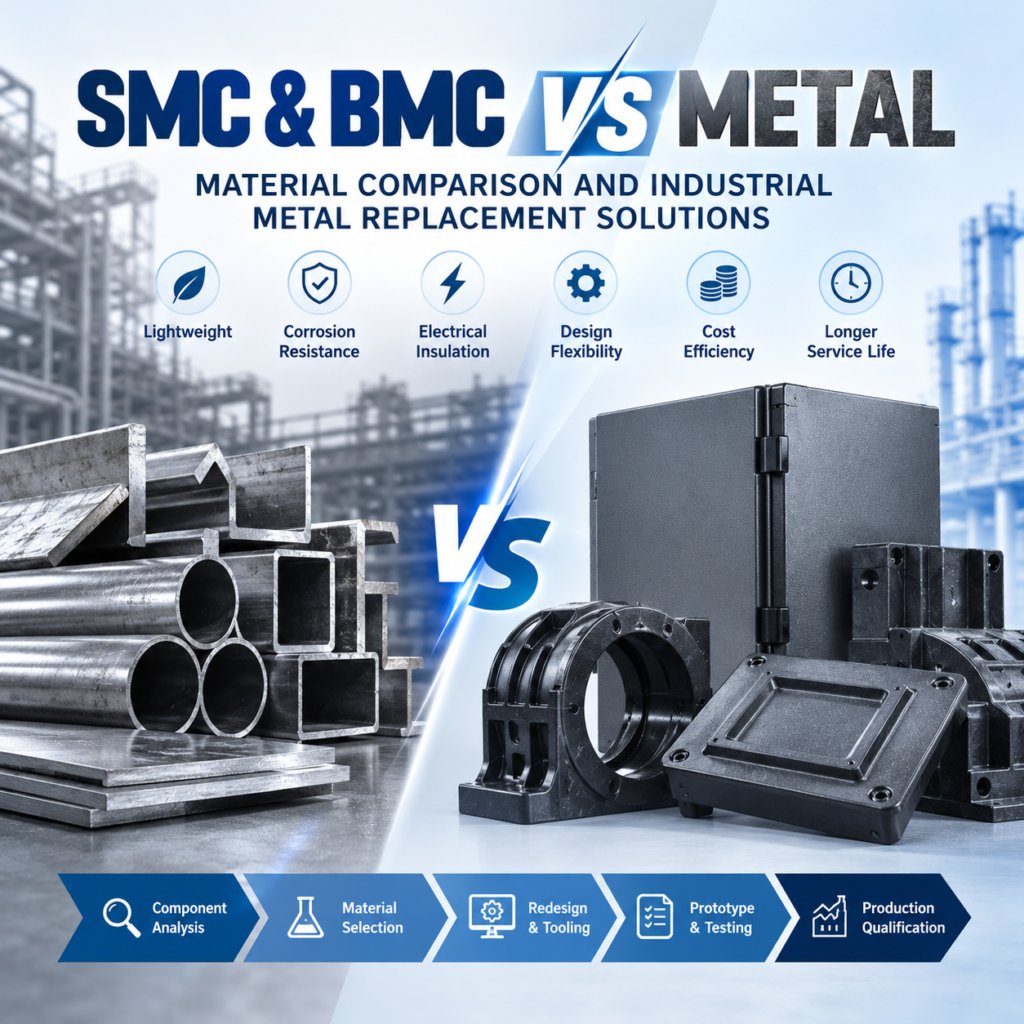
When evaluating SMC vs metal or BMC vs metal, manufacturers must look beyond material price and tensile strength. Steel and aluminum offer established structural performance, but corrosion, weight, electrical conductivity and complex assembly requirements can increase lifecycle costs. Metal replacement with composites offers an alternative, particularly where SMC and BMC materials can combine structural reinforcement, electrical insulation and complex component geometries in a single molded solution.
TL;DR: Key Engineering Insights
Weight reduction: Typical SMC/BMC densities of 1.7–2.1 g/cm³ are substantially lower than steel and generally lower than aluminum.
Electrical insulation: Insulating-grade SMC/BMC can replace certain metallic structures where electrical isolation is an essential design requirement.
Corrosion resistance: Properly formulated thermoset composites can reduce corrosion-related maintenance in aggressive industrial environments.
Design integration: Compression molding can combine ribs, mounting features, bosses and complex geometry, potentially reducing secondary operations.
Engineering limitations: SMC/BMC generally have lower elastic modulus than steel or aluminum. Successful metal replacement requires structural redesign, performance validation and lifecycle cost evaluation.
1. SMC and BMC vs Metal: Understanding the Material Differences
The fundamental difference between metals and SMC/BMC composites lies in their material structure.
Steel and aluminum are generally isotropic engineering materials, meaning their mechanical properties are relatively consistent across directions.
Sheet Molding Compound (SMC) and Bulk Molding Compound (BMC) are fiber-reinforced thermoset composites consisting of resin, reinforcement, fillers and functional additives.
Their properties depend on resin chemistry, glass-fiber content, fiber length, orientation, filler distribution and molding conditions.
When comparing SMC vs steel, SMC vs aluminum or BMC vs aluminum, engineers should distinguish between material-level properties and finished-component performance.
Material property comparison
The following values are representative engineering ranges, not guaranteed specifications for every commercial grade.
Property | SMC/BMC | Carbon Steel | Aluminum Alloy |
|---|---|---|---|
Density | 1.7–2.1 g/cm³ | ~7.85 g/cm³ | ~2.70 g/cm³ |
Tensile strength | ~30–150 MPa | ~350–600 MPa | ~150–350 MPa |
Elastic modulus | ~8–20 GPa | ~200 GPa | ~69 GPa |
Electrical conductivity | Usually insulating grades; formulation-dependent | Conductive | Conductive |
Corrosion resistance | Generally good; chemical-dependent | Often requires protection | Environment-dependent |
Thermal conductivity | Generally low | Moderate | High |
Complex geometry | Excellent molding flexibility | Forming, casting or machining | Forming, casting or machining |
Surface treatment | Often unnecessary for corrosion protection | Frequently required | Application-dependent |
Note: Mechanical ranges are illustrative, vary significantly by grade and test direction, and are not design allowables. High-performance continuous-fiber composites and specialty alloys may fall outside these ranges.
Why density alone does not determine weight savings
SMC/BMC materials have lower density than most structural metals, but the final component may require thicker walls or additional reinforcement to achieve equivalent stiffness.
Therefore, actual weight reduction should be calculated from the redesigned component rather than directly from the density ratio.
Key Takeaways
SMC/BMC offer lower density and greater electrical insulation potential than conventional metals.
Steel and aluminum generally provide significantly higher elastic modulus.
Finished-part performance depends on geometry, reinforcement and loading conditions.
Internal Link Suggestion: Explore SUSDURA Composite Materials and Manufacturing
2. Why Manufacturers Are Replacing Metal with SMC and BMC
The growing interest in composite materials vs metal is driven by more than lightweight construction.
Industrial manufacturers increasingly evaluate materials based on total manufacturing complexity, environmental durability and long-term operating costs.
2.1 Weight reduction
Lower-density composite materials can reduce component weight, potentially improving handling, transportation and installation efficiency.
This is particularly valuable for large equipment enclosures, protective housings and nonmetallic structural supports.
2.2 Corrosion resistance
Steel components exposed to humidity, chemicals or saltwater may require galvanizing, painting or stainless-steel alternatives.
Properly selected SMC/BMC formulations can offer useful resistance to corrosion-related degradation without conventional metallic protective coatings.
2.3 Electrical insulation
Metal components conduct electricity and may require separate insulation barriers, coatings or insulating inserts.
Electrical-grade SMC/BMC can integrate insulation and mechanical support within the same component, provided the finished design satisfies electrical and mechanical requirements.
2.4 Part consolidation
Complex molded geometries can integrate ribs, mounting bosses and reinforcing features that would otherwise require multiple metallic parts.
This can reduce welding, machining, assembly and fastening operations.
2.5 Maintenance reduction
In suitable environments, composite components can reduce repainting, corrosion inspection and replacement associated with metallic corrosion.
2.6 Manufacturing economics
For medium- and high-volume programs, repeatable molding cycles and reduced secondary processing may improve production economics.
However, the initial mold investment must be justified by expected production volume.
Key Takeaways
Lightweight metal replacement materials can improve product handling and installation efficiency.
Corrosion resistance and electrical insulation are often stronger replacement drivers than tensile strength.
Manufacturing cost savings depend on part complexity, volume and tooling investment.
Internal Link Suggestion: Learn More About SUSDURA SMC/BMC Manufacturing
3. Industrial Applications: Where Can SMC and BMC Replace Metal?
Industrial composite metal replacement is most attractive when the component requires a combination of structural support, environmental resistance and functional properties that metals cannot provide without additional processing.
Rather than replacing every metallic component, engineers should identify applications where composites offer measurable system-level advantages.
Industrial metal replacement application matrix
Industry | Traditional metal component | Potential SMC/BMC alternative | Primary engineering benefit |
|---|---|---|---|
Power Distribution | Metal equipment supports | SMC structural supports | Electrical insulation and corrosion resistance |
Electrical Equipment | Steel cabinets | SMC electrical enclosures | Electrical isolation and weather resistance |
Renewable Energy | Steel protective housings | SMC molded housings | Reduced corrosion and weight |
EV & Energy Storage | Aluminum/steel covers | SMC battery enclosures | Electrical insulation and design integration |
Railway | Metal equipment cabinets | SMC equipment enclosures | Corrosion resistance and lower weight |
Petrochemical | Metal cable supports | SMC cable clamps | Chemical and corrosion resistance |
Infrastructure | Metal access covers | SMC composite covers | Handling and maintenance advantages |
Industrial Machinery | Metal protective guards | SMC/BMC molded guards | Integrated geometry and insulation |
Electrical and power distribution equipment
In switchgear and electrical infrastructure, insulating SMC/BMC materials can support busbars, insulating barriers and selected structural assemblies.
An SMC electrical enclosure vs metal enclosure comparison should consider dielectric properties, corrosion resistance, impact requirements, electromagnetic shielding and grounding.
Energy storage and automotive applications
SMC automotive metal replacement may be attractive for selected battery covers, protective housings and structural accessories.
However, thermal management, crashworthiness, flame performance and electrical safety must be validated at the assembly level.
Petrochemical and infrastructure applications
For cable supports and exposed industrial structures, SMC/BMC may provide corrosion resistant metal alternatives.
Chemical compatibility, static-electricity requirements and sustained mechanical loads must be considered before specifying a replacement.
Key Takeaways
Electrical equipment, industrial housings and cable management are promising replacement applications.
Metal replacement is particularly attractive where corrosion resistance and electrical insulation provide additional value.
Safety-critical components require application-specific engineering verification.
Internal Link Suggestion: Explore SUSDURA Industrial Composite Solutions
4. Engineering Challenges in Metal-to-SMC/BMC Conversion
Successful SMC metal replacement and BMC metal replacement require more than substituting one material for another.
A metal component designed around the stiffness, ductility and thermal behavior of steel or aluminum may not perform adequately when molded with a glass-fiber-reinforced thermoset using the original geometry.
4.1 Structural stiffness and wall thickness
Steel has an elastic modulus of approximately 200 GPa, while many conventional SMC formulations have substantially lower modulus.
For a bending-dominated component, deflection depends on both material modulus and the section’s second moment of area.
A simplified beam relationship is:
Where \(F\) is load, \(L\) is span, \(E\) is elastic modulus and \(I\) is the second moment of area.
A lower-modulus material can sometimes compensate through greater section depth, optimized ribs or improved structural geometry.
4.2 Fiber orientation and load transfer
SMC reinforcement orientation changes during material flow inside the mold.
Local fiber alignment can affect tensile strength, bending performance and crack resistance.
Charge placement and molding flow therefore become important structural design considerations.
4.3 Fastening and assembly
Metal components can accommodate threaded holes, welding and concentrated loads.
SMC/BMC designs may require molded-in inserts, increased bearing areas, reinforced bosses or alternative fastening strategies.
4.4 Long-term durability
Engineers must consider creep, fatigue, thermal cycling, impact loading and moisture exposure.
The material should also be assessed against operating temperature, dimensional stability and chemical compatibility requirements.
4.5 Electrical and regulatory requirements
Replacing a conductive metallic enclosure with an insulating composite may change grounding, electromagnetic shielding, heat dissipation and fire-safety characteristics.
These functions must be addressed at the equipment level.
Key Takeaways
Successful metal replacement requires component redesign rather than direct material substitution.
Reinforcement geometry and load paths are critical to structural performance.
Long-term mechanical and environmental validation should precede mass production.
Internal Link Suggestion: Explore SUSDURA Tooling and Compression Molding Capabilities
5. Cost Comparison: Is SMC/BMC Cheaper Than Steel or Aluminum?
When comparing SMC vs aluminum cost or the economics of fiberglass reinforced composites vs steel, material price alone is not a reliable indicator of the final manufacturing cost.
A meaningful comparison should consider the complete lifecycle of the component, including tooling, processing, assembly, transportation and maintenance.
5.1 Raw material and manufacturing costs
Steel is generally economical for simple fabricated structures, particularly at low production volumes.
Aluminum offers lower density and good manufacturability but may require machining, casting, surface finishing or additional assembly operations.
SMC/BMC typically require dedicated molds and process development. However, compression molding can manufacture complex, near-net-shape components with integrated functional features.
For a component requiring multiple metallic parts, machining operations and corrosion-protection treatments, SMC/BMC may reduce the number of manufacturing steps.
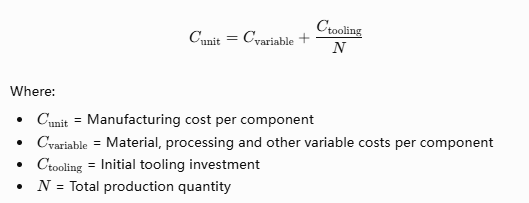
5.2 Production volume and tooling amortization
Tooling cost is an important consideration in thermoset composites vs metal comparisons.
A simplified cost model is:




6. SUSDURA Metal Replacement Engineering Solutions
As a custom SMC BMC manufacturer, SUSDURA integrates material formulation, tooling development, molding and laboratory testing to support industrial composite component development.
For customers considering a composite material replacement for steel or aluminum, SUSDURA focuses on matching the material system and component geometry to the application’s functional requirements.
6.1 Customized SMC/BMC material formulation
SUSDURA develops thermoset composite formulations using selected resin systems, glass-fiber reinforcement, fillers and functional additives.
Material development can target electrical insulation, dimensional stability, flame-retardant performance, mechanical strength or resistance to specific chemical environments.
6.2 Integrated tooling and manufacturing
SUSDURA operates compression molding equipment ranging from 50 to 2,500 tons, together with BMC injection molding and transfer molding capabilities.
Its tooling operations support mold design, precision machining and dimensional verification.
This integration allows material characteristics, mold geometry and production parameters to be considered together during product development.
6.3 Engineering validation and quality control
SUSDURA’s laboratory capabilities include mechanical testing, electrical insulation evaluation, dielectric breakdown testing, flame-retardancy testing and dimensional inspection.
Production controls can include raw-material verification, process parameter monitoring, dimensional inspection and batch traceability.
6.4 Application experience
SUSDURA’s industrial experience includes electrical equipment structural components, composite enclosures, cable-support products and chemically resistant SMC components.
These applications illustrate how composite materials can provide functional advantages beyond weight reduction.
However, each metal-to-composite conversion requires its own technical and economic assessment.
7. Engineering Standards and Performance Validation
Metal-to-Composite Conversion Workflow
SUSDURA | From Metal Component Analysis to Composite Production Qualification
8. FAQ: SMC and BMC vs Metal
1. Is SMC stronger than steel or aluminum?
Not generally when comparing conventional material-level tensile strength or elastic modulus.
Steel and many aluminum alloys provide higher stiffness and tensile strength than standard glass-fiber SMC/BMC formulations.
However, a properly redesigned SMC component may satisfy the same functional load requirements as a metal component while offering lower weight, electrical insulation or improved corrosion resistance.
The comparison should be based on finished-component performance rather than material strength alone.
2. Can SMC and BMC completely replace metal components?
No. SMC/BMC cannot universally replace steel, aluminum or stainless steel.
They are suitable candidates for selected applications involving electrical insulation, corrosion resistance, complex molded geometry and moderate structural loading.
Components requiring very high stiffness, elevated-temperature strength, high thermal conductivity or specific metallic functions may remain better suited to metals.
Successful replacement requires application-specific engineering analysis and validation.
3. Is SMC more cost-effective than aluminum for industrial applications?
SMC can be more cost-effective for certain medium- or high-volume components, especially when complex geometry, integrated features and reduced secondary processing provide manufacturing advantages.
However, tooling investment, production volume, material formulation and performance requirements strongly influence cost.
For low-volume or simple components, aluminum may remain more economical.
A total cost of ownership comparison is recommended before selecting the replacement material.
9. Conclusion: Choosing the Right Material for Industrial Metal Replacement
The comparison of SMC vs metal and BMC vs metal demonstrates that material selection should be based on functional performance rather than individual mechanical properties.
In SMC vs steel and SMC vs aluminum applications, composites offer potential advantages in weight reduction, corrosion resistance, electrical insulation and design integration. Similarly, BMC vs aluminum comparisons may reveal opportunities for complex molded electrical and industrial components.
However, successful metal replacement with composites requires careful evaluation of stiffness, structural loads, temperature, environmental durability and production economics.
For manufacturers considering SMC metal replacement, BMC metal replacement or broader industrial composite metal replacement, working with an integrated material and molding supplier can simplify development and qualification.
Partner with SUSDURA for Custom SMC/BMC Metal Replacement Solutions
SUSDURA supports industrial OEMs seeking to replace selected steel and aluminum components with engineered thermoset composites.
Our capabilities cover customized material formulation, tooling design, SMC/BMC molding, laboratory testing and volume manufacturing.
To evaluate your project, please provide:
Existing metal component drawings or 3D models.
Current material grade and component weight.
Mechanical, electrical and environmental requirements.
Annual production quantity and target cost.
Required testing standards and approval criteria.