Industrial equipment operating in potentially explosive atmospheres must address electrostatic discharge risks without compromising mechanical strength, corrosion resistance or long-term reliability. Conventional insulating plastics may accumulate static charge, while metallic components can introduce corrosion and electrical continuity challenges. Antistatic SMC material and antistatic BMC material offer a customizable composite solution, combining engineered electrical behavior with the structural advantages of glass-fiber-reinforced thermosets.
TL;DR: Key Engineering Insights
Controlled electrical properties: Antistatic SMC and BMC materials can be formulated to dissipate electrostatic charge through carefully selected conductive or static-dissipative additives.
Mechanical performance: Glass-fiber reinforcement provides stiffness, dimensional stability and structural strength for demanding industrial components.
Application flexibility: Potential applications include cable clamps, electrical enclosures, industrial supports and equipment components used in hazardous environments.
Application-specific validation: Antistatic properties alone do not establish explosion-proof certification. Material performance and finished-equipment compliance must be evaluated separately.
SUSDURA engineering capability: Customized SMC formulations, compression molding, tooling development and laboratory testing support the development of specialized industrial composite components.
1. Why Antistatic Materials Matter in Hazardous Environments
Electrostatic discharge is an important consideration in industrial environments where flammable gases, vapors, mists or combustible dust may be present.
In petrochemical facilities, offshore platforms, mining operations and chemical processing plants, electrostatic charge can accumulate through material contact, friction, separation, particle movement or other operating processes.
When accumulated charge discharges under unfavorable conditions, it may become a potential ignition source.
Limitations of conventional materials
Metallic components provide electrical conductivity but may require additional corrosion protection, electrical bonding or insulation, depending on the installation.
Conventional engineering plastics offer electrical insulation and low weight, but highly insulating surfaces can retain electrostatic charge under certain conditions.
This creates a challenging material-selection problem: engineers may need mechanical strength, corrosion resistance and controlled electrostatic behavior in the same component.
Antistatic fiberglass composites offer an alternative by combining reinforcing fibers with thermoset resin systems designed for specific electrical requirements.
However, materials marketed as explosion proof composite materials must be evaluated carefully. A material’s antistatic performance does not independently establish that equipment manufactured from it is suitable for a classified hazardous area.
Key Takeaways
Static charge accumulation is a potential ignition concern in certain hazardous environments.
Material selection must consider electrical behavior, mechanical loading and operating conditions.
Antistatic performance is one part of a complete hazardous-area safety assessment.
Internal Link: Explore SUSDURA Composite Manufacturing Capabilities
2. Engineering Properties of Antistatic SMC and BMC Materials
Standard SMC and BMC formulations are generally designed around mechanical, thermal, dimensional and electrical insulation requirements.
For applications involving electrostatic hazards, the formulation may need to be modified to achieve controlled charge dissipation.
This is where antistatic SMC and BMC materials differ from conventional electrical-grade molding compounds.
2.1 Customized conductive and static-dissipative formulations
A custom antistatic SMC formulation may incorporate carbon-based additives, conductive fillers or other engineered additive systems.
The objective is to establish a suitable electrical pathway without unnecessarily sacrificing the material’s structural performance.
Possible formulation strategies include:
Conductive carbon black for controlled electrical resistance.
Graphite or other conductive additives for electrical-property modification.
Selected conductive fibers for specialized composite applications.
Resin and additive optimization to maintain processability and mechanical integrity.
A conductive SMC material or conductive BMC compound may exhibit electrical properties significantly different from conventional insulating SMC/BMC grades.
Importantly, conductive, static-dissipative and electrically insulating are not interchangeable material classifications.
2.2 Balancing mechanical strength and electrical properties
Adding conductive fillers can influence resin viscosity, molding flow, fiber wet-out, surface finish and mechanical properties.
The formulation must therefore balance electrical performance with glass-fiber content, reinforcement distribution and curing behavior.
For structural products such as cable clamps, excessive formulation changes may reduce toughness or create unfavorable local stress concentrations.
SUSDURA approaches specialized SMC development by considering material formulation and compression molding requirements together.
Key Takeaways
Antistatic behavior requires deliberate formulation and verification.
Conductive additives can change both processing behavior and mechanical performance.
Electrical properties must be evaluated alongside structural requirements.
Internal Link: Explore SUSDURA SMC/BMC Material Solutions
3. Typical Industrial Applications of Antistatic SMC and BMC
The combination of high stiffness, corrosion resistance, dimensional stability and engineered electrical behavior makes antistatic thermoset composites candidates for demanding industrial applications.
3.1 Oil, gas and petrochemical facilities
Potential applications include nonmetallic equipment supports, protective components, cable management systems and selected enclosure components.
An SMC material for hazardous environments may be considered when metallic corrosion is a concern and electrostatic properties must be controlled.
For offshore facilities, resistance to moisture, salt exposure and industrial chemicals may also influence material selection.
3.2 Mining and industrial processing
Mining and material-handling environments can involve dust, mechanical vibration, abrasion and electrostatic charging.
A BMC material for hazardous areas may be suitable for certain smaller, geometrically complex molded components where the applicable electrical and mechanical requirements can be demonstrated.
3.3 Electrical enclosures and cable management
Antistatic electrical enclosures, antistatic cable clamps and composite cable cleats are potential applications for specially formulated composites.
SMC compression molding is particularly useful for larger structural geometries, while BMC injection or compression molding can support smaller components with intricate features.
Nevertheless, an enclosure intended for an explosive atmosphere must satisfy the applicable protection concept and equipment certification requirements.
Key Takeaways
Antistatic SMC/BMC can be evaluated for structural and protective industrial components.
Application suitability depends on environmental exposure, electrical properties and mechanical loads.
Hazardous-area equipment requirements extend beyond the properties of the molding compound.
Internal Link: Explore SUSDURA Industrial FRP Solutions
4. SUSDURA Case Study: Custom Antistatic SMC Cable Clamps
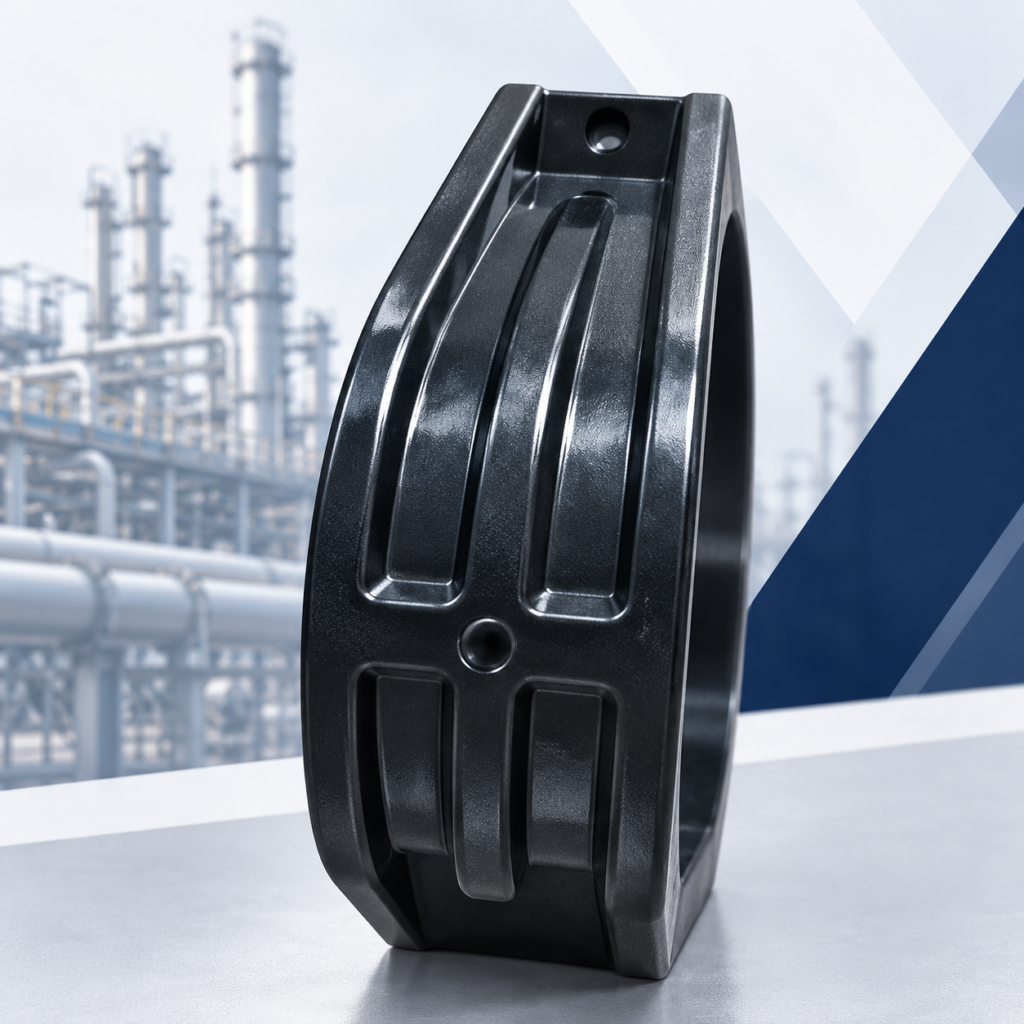
One practical example of specialized composite engineering is the development of customized SMC cable clamps for an industrial customer requiring a combination of mechanical strength and antistatic material properties.
Cable clamps may appear to be simple components, but their performance can influence cable positioning, mechanical stability and the reliability of an entire cable management system.
4.1 Customer requirements and engineering challenges
The customer application called for a nonmetallic cable-clamping solution with several important performance objectives:
Controlled electrostatic behavior to address the application’s static-charge requirements.
Sufficient mechanical strength to withstand cable clamping and installation loads.
High structural rigidity to maintain stable cable positioning.
Corrosion resistance for demanding industrial environments.
Dimensional consistency for repeatable assembly and installation.
Conventional insulating SMC can provide excellent mechanical properties, but its electrical behavior may not satisfy a customer’s antistatic requirements without modification.
The engineering challenge was therefore to develop an SMC material system that balanced electrostatic performance with the structural properties required for the finished cable clamp.
4.2 Customized SMC material formulation
SUSDURA’s development approach combined glass-fiber reinforcement with a customized thermoset formulation.
The formulation strategy focused on three interconnected requirements:
Electrical performance: Establishing a suitable resistance range through material formulation, subject to verification against the customer’s acceptance criteria.
Mechanical performance: Maintaining reinforcement effectiveness, stiffness and resistance to cracking around critical clamping features.
Molding performance: Controlling compound flow, curing behavior and dimensional consistency during compression molding.
Because electrical additives can influence mechanical properties and processing behavior, the formulation must be evaluated as a complete composite system rather than as a simple additive modification.
4.3 Tooling and compression molding
SUSDURA integrates material development with tooling engineering and SMC compression molding.
For cable-clamping components, important design considerations include bolt-hole reinforcement, contact-surface geometry, wall-thickness transitions and potential stress concentrations.
Production development can incorporate controlled charge placement, molding temperature, pressure and curing parameters to improve consistency.
4.4 Engineering validation
A suitable validation program includes electrical resistance measurements, mechanical load testing, dimensional inspection and environmental conditioning.
The final acceptance criteria must be established from the customer’s application requirements.
This case illustrates how customized material formulation and compression molding can be combined to develop specialized fiberglass reinforced cable clamps.
Key Takeaways
The cable clamp case demonstrates the importance of balancing electrical and mechanical requirements.
Custom formulation must be developed alongside tooling and molding parameters.
Final product suitability depends on measured performance and application-specific acceptance criteria.
Internal Link: Learn More About SUSDURA’s SMC Compression Molding Capabilities
5. Testing, Standards and Material Selection for Antistatic SMC/BMC
Engineering qualification of antistatic composite materials requires more than a general declaration of electrical conductivity.
The testing program must establish whether the material and finished component meet the electrical, mechanical and environmental requirements of the intended application.
5.1 Surface resistance and resistivity
SMC surface resistivity and surface resistance are important parameters for evaluating electrostatic behavior.
However, they represent different physical quantities and should not be reported interchangeably.
Surface resistance describes resistance measured across a defined surface electrode arrangement, while surface resistivity is a geometry-dependent material characterization derived using the applicable method.
IEC 61340-2-3:2016 provides methods for determining resistance and resistivity of solid materials used to avoid electrostatic charge accumulation.
5.2 Hazardous-area equipment requirements
IEC 60079-0:2026 specifies general requirements for the construction, testing and marking of Ex Equipment and Ex Components intended for explosive atmospheres.
It is important to distinguish material characterization from finished-equipment qualification.
A material with favorable antistatic properties does not automatically qualify a cable clamp, enclosure or other component for use in a particular hazardous area.
Equipment classification, installation conditions, potential ignition sources and applicable protection requirements must also be considered.
5.3 Mechanical and environmental verification
For flame retardant antistatic composites, additional testing may include:
Tensile, flexural and impact performance.
Clamp loading and resistance to cracking.
Surface and volume electrical resistance.
Flame-retardancy testing under specified conditions.
Humidity, temperature and chemical-exposure conditioning.
Dimensional stability and batch-to-batch consistency.
For BMC electrical properties, filler dispersion, molding parameters and reinforcement distribution should also be evaluated.
Engineering Testing Matrix
Test parameter | Engineering purpose | Reference or method |
|---|---|---|
Surface resistance | Evaluate surface charge-dissipation characteristics | IEC 61340-2-3 |
Surface resistivity | Characterize electrical behavior of the material surface | IEC 61340-2-3 |
Hazardous-area suitability | Assess applicable Ex equipment requirements | IEC 60079-0 |
Tensile strength | Evaluate material load-bearing behavior | ISO 527 |
Flexural strength | Evaluate stiffness and bending resistance | ISO 178 |
Flammability | Characterize specified burning behavior | UL 94, where applicable |
Environmental aging | Evaluate durability under service conditions | Application-specific protocol |
Clamp mechanical performance | Evaluate structural reliability and cable retention | Product-specific loading and acceptance criteria |
The appropriate test method, specimen geometry, conditioning procedure and acceptance limits should be agreed upon before qualification testing.
For cable cleats subject to short-circuit electrodynamic forces, IEC 61914 may also be relevant to finished-product evaluation.
Key Takeaways
Electrical resistance and resistivity measurements require defined test conditions.
Material testing is not equivalent to hazardous-area equipment certification.
Mechanical, electrical and environmental tests should be combined into a documented qualification program.
External Standards References:
IEC 61340-2-3:2016 — Electrostatic Resistance and Resistivity Testing
IEC 60079-0:2026 — Explosive Atmospheres: Equipment General Requirements
Internal Link: Explore SUSDURA’s Material Testing and Quality Control Capabilities
6. How to Select an Antistatic SMC or BMC Manufacturer
Selecting an antistatic SMC manufacturer requires a different evaluation approach from sourcing conventional molding compounds.
For specialized industrial applications, material development, process control and engineering validation are often more important than selecting a standard commercial grade.
6.1 Material formulation capability
A qualified supplier should understand how conductive additives interact with resin chemistry, glass-fiber reinforcement and molding behavior.
The supplier should also be able to explain the trade-offs between conductivity, mechanical strength, surface quality and processing stability.
6.2 Manufacturing process control
Repeatable electrical performance depends partly on consistent raw-material dosing, additive distribution, fiber content and processing conditions.
SUSDURA operates integrated SMC/BMC material manufacturing and molding operations, supporting formulation development and finished-component production.
Its SMC manufacturing capability includes automated raw-material dosing and X-ray-based sheet-weight monitoring.
These systems help control material consistency, although electrical resistance must still be verified through appropriate testing.
6.3 Tooling and product engineering
For complex structural components, the manufacturer should consider:
Reinforcement distribution and material flow.
Bolt-hole and insert reinforcement.
Dimensional tolerances and mold design.
Potential cracking and deformation under load.
Inspection requirements for mass production.
An integrated material and molding supplier can evaluate these factors earlier in development.
6.4 Documentation and traceability
Industrial customers should request material specifications, electrical test data, mechanical test reports and applicable quality records.
For specialized formulations, batch traceability and documented acceptance criteria are particularly important.
Key Takeaways
Formulation expertise is essential for balancing electrical and mechanical performance.
Process consistency supports repeatable production quality.
Test documentation and traceability should form part of the supplier qualification process.
Internal Link: Discover SUSDURA Manufacturing and Engineering Solutions
7. FAQ: Antistatic SMC and BMC Materials
1. What is the difference between antistatic SMC and conventional SMC material?
Conventional SMC is typically formulated for mechanical strength, dimensional stability and application-specific electrical insulation.
Antistatic SMC is engineered to provide controlled electrostatic behavior through selected conductive or static-dissipative additives.
The appropriate electrical resistance range depends on the intended application and relevant safety requirements.
2. Can antistatic SMC and BMC materials be used in explosion-hazardous environments?
Potentially, but material properties alone do not establish suitability.
Antistatic SMC/BMC components must be evaluated according to their intended function, installation environment, applicable equipment standards and ignition-risk assessment.
An antistatic material is not automatically an explosion-proof or Ex-certified product.
3. Can SUSDURA manufacture custom antistatic SMC cable clamps?
SUSDURA supports customized SMC cable clamp development through material formulation, tooling engineering, compression molding and laboratory testing.
Customers can provide drawings, operating conditions, required electrical properties, mechanical loading requirements and annual demand for engineering evaluation.
8. Conclusion: Custom Antistatic SMC and BMC Solutions from SUSDURA
Antistatic SMC material and antistatic BMC material provide opportunities to develop specialized composite components for industrial environments requiring controlled electrostatic behavior, mechanical strength and corrosion resistance.
Compared with conventional insulating compounds, static dissipative SMC, conductive SMC material and customized BMC formulations require additional engineering attention to electrical resistance, reinforcement behavior and manufacturing consistency.
The SUSDURA cable clamp case demonstrates the value of integrating material development with component design and compression molding.
For customers evaluating antistatic SMC and BMC materials, selecting an experienced manufacturing partner can help reduce development complexity and improve the reliability of application-specific qualification.
Develop Your Custom Antistatic Composite Components with SUSDURA
SUSDURA provides integrated engineering and manufacturing support for customized SMC/BMC materials and molded components.
Our capabilities include material formulation, mold development, compression molding, electrical testing, mechanical validation and production quality control.
Whether you require antistatic cable clamps, composite cable cleats, antistatic electrical enclosures or other specialized thermoset components, our engineering team can evaluate your application requirements.