As electric vehicles, energy-storage systems and high-power electrical equipment become more energy-dense, conventional flame-retardant composites are being pushed beyond simple self-extinguishing requirements. Customers increasingly need high flame-retardant SMC material that can resist intense thermal exposure, delay flame penetration, control through-thickness degradation and maintain useful structural integrity. This challenge led SUSDURA to develop a customized thermal-barrier SMC formulation rather than simply increasing flame-retardant additives.
TL;DR
- Conventional UL 94 flame performance does not automatically mean an SMC can act as a thermal barrier under extreme heat.
- SUSDURA’s development focused on balancing the resin matrix, flame-retardant system, mineral fillers and glass-fiber reinforcement.
- Increasing flame-retardant filler alone can reduce SMC flow, fiber wet-out, surface quality and mechanical performance.
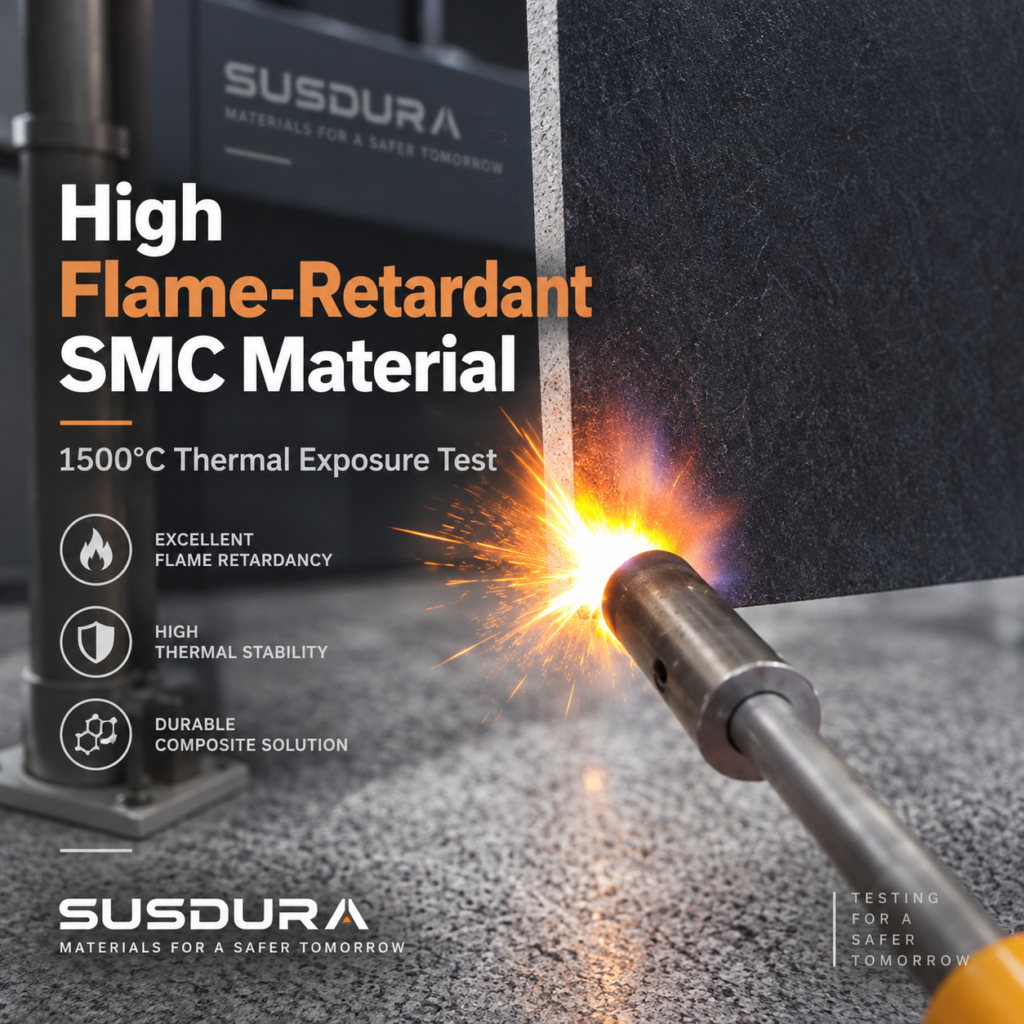
- Molded samples were evaluated under customer-defined extreme thermal exposure using a heat source of approximately 1500°C.
- The final challenge was not only formulation development, but reproducing the same high flame-retardant SMC material consistently in commercial production.
Why Conventional Flame-Retardant SMC Was No Longer Enough
Traditional flame-retardant SMC material is commonly designed around ignition resistance, flame propagation, after-flame behavior and self-extinguishing performance. UL 94, for example, evaluates polymeric materials through controlled small-scale flame tests and assigns classifications based on their burning characteristics.
UL Solutions — Combustion and UL 94 Testing for Plastics
These tests remain important, but some new-energy applications introduce a fundamentally different thermal challenge.
Instead of a relatively small ignition source followed by removal of the flame, a composite structure may encounter intense flame, high heat flux, hot-gas erosion, rapid thermal shock and continued exposure while the heat source remains active.
The engineering question therefore changes from:
Will the material stop burning after ignition?
to:
Can the material continue acting as a barrier while extreme heat is still attacking it?
This distinction became increasingly relevant as battery and energy-storage safety requirements evolved. China’s current GB 38031-2025, for example, took effect on July 1, 2026 and replaced GB 38031-2020.
Official GB 38031-2025 Standard Information
For SUSDURA, however, the development question was fundamentally a material question, not a battery-cover question.
Passing a conventional flame-retardancy test does not automatically make an SMC a thermal-barrier material.
Key Takeaways
- UL 94 classification and extreme thermal-barrier performance address different material behaviors.
- Severe thermal exposure introduces heat transfer, erosion, cracking and penetration mechanisms.
- Advanced applications require SMC development beyond conventional self-extinguishing performance.
Defining the Target Performance of the New SMC Material
Before modifying a formulation, SUSDURA first needed to define what the new material was actually expected to accomplish.
Simply requesting a “more flame-retardant SMC” provides insufficient engineering direction. A material can show excellent after-flame behavior while still transferring heat rapidly through its thickness. Another formulation may resist flame penetration but become so heavily filled that it cannot flow reliably during compression molding.
The development target therefore had to combine thermal, mechanical and manufacturing properties.
| Material Property | Development Target |
|---|---|
| Flame resistance | Prevent or minimize sustained combustion |
| Flame penetration resistance | Delay through-thickness burn-through |
| Thermal barrier performance | Reduce and slow heat transfer |
| Char stability | Develop a more protective degraded surface |
| Thermal shock resistance | Limit severe cracking and material separation |
| Structural integrity | Maintain useful reinforcement framework |
| Moldability | Preserve sufficient SMC flow |
| Mechanical properties | Retain usable mechanical performance |
| Electrical insulation | Maintain required insulation capability |
| Dimensional stability | Control shrinkage and warpage |
| Batch consistency | Enable stable commercial production |
This matrix changed the project from a conventional flame-retardant adjustment into a broader custom SMC formulation program.
Every improvement had to be evaluated against the other requirements. Improving flame performance at the cost of processing stability would not represent a successful industrial material.
Key Takeaways
- Material development should begin with failure modes, not additive selection.
- Thermal performance and processability must be developed simultaneously.
- A high-performance SMC requires a multi-property optimization target.
Internal Link Suggestion: Explore SUSDURA custom SMC material development and laboratory testing capabilities.
Why Simply Adding More Flame Retardant Does Not Work
A common assumption in flame-retardant compound development is straightforward:
Need better flame resistance → add more flame retardant.
In practical SMC formulation, the relationship is much more complicated.
Many flame-retardant and mineral filler systems increase the solid loading of the resin paste. As loading increases, paste viscosity can rise substantially. Higher viscosity can affect glass-fiber impregnation, compound flow, cavity filling and surface reproduction.
At excessive loading levels, developers may encounter:
Flame resistance ↑
but simultaneously:
Viscosity ↑
Density ↑
Flowability ↓
Fiber wet-out ↓
Mechanical performance ↓
Surface quality ↓
Molding stability ↓
This is especially important for sheet molding compound, where the material must mature to a controllable handling condition and later flow under heat and pressure through a compression mold.
A formulation that performs exceptionally during a small flame test but cannot consistently fill the mold is not an industrially useful SMC.
SUSDURA therefore approached the project around one principle:
High Flame Retardancy Is a Formulation Balance Problem
The development target was not to maximize the percentage of flame-retardant filler. It was to create a balanced resin–filler–fiber system capable of providing improved thermal protection without destroying the fundamental processing characteristics of SMC.
Key Takeaways
- More flame-retardant filler does not automatically produce a better SMC.
- Excess filler can negatively affect viscosity, flow and reinforcement impregnation.
- Industrial material development requires balance rather than a single maximized property.
Step 1: Redesigning the Resin Matrix
SUSDURA did not begin the project simply by increasing the flame-retardant package. The first step was to reconsider the resin matrix itself.
During extreme thermal exposure, the polymer matrix begins to undergo thermal decomposition. The rate and mode of that decomposition influence flame propagation, gas generation, surface degradation, char formation and the speed at which heat progresses deeper into the composite.
Several formulation variables therefore had to be considered together:
- resin backbone and chemistry;
- thermal decomposition behavior;
- crosslink density;
- heat resistance;
- char-forming behavior;
- resin-to-filler compatibility;
- reinforcement wet-out;
- processing viscosity;
- cure characteristics.
This is important because flame retardancy and thermal-barrier behavior are not identical.
An additive may reduce visible flaming while the underlying polymer matrix still degrades rapidly under sustained high heat. Conversely, a carefully designed resin system can support a more stable protective surface layer and slow the progression of degradation through the material thickness.
At the same time, SMC is a processing material. Any change to the resin influences paste viscosity, thickening behavior, maturation, cure rate and mold flow.
The challenge was therefore to establish a matrix that could support the thermal-protection system without sacrificing the manufacturing window required for commercial compression molding.
Step 2: Engineering the Flame-Retardant and Thermal-Barrier System
Once the resin platform was established, SUSDURA could optimize the flame-retardant and thermal-barrier package.
Rather than relying on one mechanism, high-performance formulations can be engineered around several complementary protection mechanisms.
Gas-Phase Suppression
Certain flame-retardant systems can interfere with combustion reactions in the gas phase, helping reduce flame propagation.
Condensed-Phase Protection
A protective surface layer can reduce direct interaction between the underlying polymer and the external heat source.
Endothermic Heat Absorption
Some mineral systems absorb heat during decomposition, reducing the amount of energy immediately transferred deeper into the material.
Char Formation
A stable charred layer can act as a temporary barrier between the severe thermal environment and the remaining composite underneath.
Thermal-Barrier Fillers
Appropriately selected fillers can influence through-thickness heat transfer and the stability of the material during thermal attack.
The important point is that these mechanisms cannot be optimized independently from processing.
Changing the flame-retardant package changes density, viscosity, resin demand, cure behavior and often the mechanical response of the final composite.
For this reason, SUSDURA treated the project not merely as a flame-retardant SMC, but as a high flame-retardant / thermal-barrier SMC material development program.
The precise formulation ratios remain proprietary. What matters is the engineering method: combine multiple protection mechanisms while preserving manufacturability.
Step 3: Optimizing the Filler–Resin–Glass Fiber Balance
The central challenge became balancing three interconnected systems:
Resin Matrix
↓
Flame-Retardant / Mineral Filler Package
↓
Glass-Fiber Reinforcement
Each contributes something different.
The resin controls impregnation, cure, adhesion and part of the thermal-decomposition behavior. The flame-retardant and mineral package contributes fire and thermal characteristics. Glass fiber provides mechanical reinforcement and helps the composite retain its physical framework as the polymer matrix begins to degrade.
But improving one side of the triangle can weaken another.
Too much filler may improve certain flame characteristics but increase viscosity.
Increasing resin may improve flow and wet-out but alter thermal behavior.
Increasing glass content can improve structural properties while reducing the amount of resin available to properly wet the reinforcement if paste rheology is not controlled.
The formulation therefore had to be evaluated as a system rather than by independently optimizing ingredient percentages.
For SUSDURA, this meant repeated adjustment of paste rheology, filler loading, reinforcement content and molding response until the material approached a usable balance between:
thermal protection + mechanical performance + electrical properties + molding flow + commercial repeatability.
This balance is one of the main differences between laboratory flame-retardant development and an industrial custom high flame-retardant SMC material.
Step 4: Controlling Glass Fiber as Part of the Thermal Barrier
Glass fiber is normally discussed in SMC primarily as a mechanical reinforcement. Under severe thermal exposure, however, its role becomes more complex.
As the resin matrix heats and begins to decompose, the reinforcement network can temporarily help the composite retain geometry and reduce rapid material separation.
The effectiveness of that network depends on several variables:
Fiber content
Fiber length
Fiber dispersion
Fiber wet-out
Local orientation
Poor reinforcement distribution can create locally weak regions. During thermal shock, these areas may become preferred locations for cracking, separation or accelerated through-thickness degradation.
Good reinforcement control does not make glass fiber itself an insulating layer capable of indefinitely resisting extreme temperatures. Rather, the glass network may help preserve a physical skeleton while the resin and protective surface layers perform their thermal-barrier functions.
For this reason, SUSDURA evaluated glass-fiber content and distribution together with the resin and filler systems instead of treating reinforcement as a completely separate mechanical variable.
This becomes especially important when moving from laboratory samples to production SMC. Variations in fiber loading or sheet uniformity can translate into variations in mechanical behavior, molding flow and local thermal performance.
The material therefore requires both formulation control and reinforcement-distribution control.
Step 5: Developing the Material Through Multiple Formulation Iterations
High-performance material development rarely follows a one-formula, one-test path.
SUSDURA used an iterative approach in which each formulation was evaluated, the dominant limitation was identified, and the next modification addressed that specific failure mechanism.
| Development Stage | Main Observation | Optimization Direction |
|---|---|---|
| Base FR-SMC | Insufficient extreme thermal barrier | Modify resin and FR system |
| Formula A | Improved flame behavior | Reduce thermal transfer |
| Formula B | Stronger thermal resistance but reduced flow | Rebalance filler/resin ratio |
| Formula C | Improved flow but localized thermal cracking | Optimize reinforcement system |
| Formula D | Better thermal and molding balance | Establish production formulation |
| Production Grade | Repeatability becomes critical | Validate manufacturing process window |
The value of this approach is that development decisions become connected to observed material behavior.
If thermal performance improves but compound flow becomes unstable, the next step is not simply adding more flame retardant.
If flow improves but local cracking appears during thermal exposure, the reinforcement or matrix balance must be revisited.
This creates a closed engineering loop:
Test → Observe → Identify Failure Mode → Modify Formula → Retest
That loop is fundamental to custom SMC development.
Step 6: Testing the SMC Under Approximately 1500°C Thermal Exposure
After formulation optimization, SUSDURA moved beyond conventional flame-retardancy evaluation and subjected molded specimens to customer-defined extreme thermal exposure using a heat source of approximately 1500°C.
This distinction is important:
1500°C refers to the thermal exposure condition, not the continuous operating temperature of the SMC.
SUSDURA does not describe the material as a “1500°C continuous-use SMC.” Instead, the test evaluates how the composite responds during short-duration exposure to an extremely severe thermal environment.
A technically meaningful test should define more than heat-source temperature.
Relevant parameters include:
- heat-source temperature;
- exposure duration;
- distance from the source;
- material thickness;
- specimen dimensions;
- front-side condition;
- back-side temperature;
- flame penetration;
- crack formation;
- post-test structural condition.
What Happens to SMC During Extreme Thermal Exposure?
Extreme thermal exposure does not produce one instantaneous failure mechanism. The material response develops progressively through the thickness.
Stage 1 — Surface Heating
The exposed surface rapidly absorbs thermal energy and its temperature rises.
Stage 2 — Resin Decomposition
As temperature increases, the thermoset matrix begins thermal decomposition. The rate of this process is strongly affected by resin chemistry and the flame-retardant system.
Stage 3 — Protective Layer Development
Depending on formulation, decomposition products, char and mineral residues can create a surface layer that partially shields the underlying composite.
Stage 4 — Reinforcement Exposure
As part of the resin disappears, glass reinforcement becomes increasingly exposed and may help the material retain a physical framework.
Stage 5 — Barrier Integrity
Eventually the engineering question becomes whether cracks, erosion and decomposition connect from the exposed face to the opposite side.
This explains why visual surface damage alone is not sufficient to judge a thermal-resistant SMC material.
Under an approximately 1500°C heat source, some surface degradation should be expected.
The more important question is:
How fast does degradation progress through the thickness?
A successful thermal-barrier formulation aims to slow that progression, limit penetration and preserve useful integrity long enough to meet the application’s defined safety target.
Key Takeaways
- Extreme heat causes progressive rather than instantaneous composite degradation.
- Surface charring does not automatically represent material failure.
- Through-thickness degradation rate is central to thermal-barrier evaluation.
Flame Resistance Is Not Enough: The Material Still Has to Mold
An SMC formula can perform well under extreme thermal exposure and still fail commercially.
Why?
Because it still has to behave like SMC.
Commercial sheet molding compound must soften and flow under heat and pressure, fill complex geometry, wet reinforcement, cure consistently and reproduce the required dimensions.
A heavily filled fire-resistant SMC material may encounter problems including:
- short flow distance;
- incomplete cavity filling;
- poor rib or boss reproduction;
- fiber/resin separation;
- increased molding pressure requirements;
- unstable cure;
- surface defects;
- dimensional variation.
For this reason, SUSDURA evaluated thermal performance together with processing properties.
| Requirement | Why It Matters |
|---|---|
| SMC flow | Complex component filling |
| Cure behavior | Stable molding cycles |
| Fiber wet-out | Mechanical consistency |
| Shrinkage | Dimensional control |
| Mechanical strength | Structural performance |
| Electrical insulation | High-voltage applications |
| Surface quality | Sealing and functional interfaces |
| Thermal resistance | Extreme heat protection |
A formulation that survives an extreme flame test but cannot reliably flow through a compression mold is not an industrial SMC material.
Key Takeaways
- Thermal performance must coexist with stable compression-molding behavior.
- Highly filled formulations require careful rheology and cure control.
- Manufacturing validation is part of material development.
How SUSDURA Maintains Batch-to-Batch Consistency
For an advanced formulation, the most difficult commercial question may not be whether the first batch performs correctly.
It is whether the same material can be reproduced in Batch 10, Batch 100 and Batch 500.
SUSDURA therefore controls key variables that influence both processing and finished-material performance.
Raw-material dosing is automated to reduce variation in resin, fillers and other formulation components. Paste preparation is controlled before the material enters the SMC line.
During sheet production, SUSDURA uses online X-ray sheet-weight monitoring to help control areal-weight consistency. Glass-fiber content is also checked because reinforcement variation can influence mechanical properties, mold flow and local composite structure.
Material from the beginning, middle and end of each batch can be evaluated for relevant characteristics including:
- viscosity;
- glass-fiber content;
- sheet weight;
- appearance;
- processing condition.
Samples are retained to support later traceability.
| Critical Variable | Potential Influence | SUSDURA Control |
|---|---|---|
| Resin/filler ratio | Thermal and processing performance | Controlled dosing |
| Paste viscosity | Impregnation and flow | Batch viscosity check |
| Glass-fiber content | Structural consistency | GF verification |
| Sheet weight | Material consistency | Online X-ray monitoring |
| Maturation | Moldability | Controlled process window |
| Storage | Material stability | Controlled cold storage |
| Batch identity | Traceability | Batch records and retained samples |
This is what converts a successful formulation into a commercial material platform.
Where High Flame-Retardant SMC Materials Can Be Applied
Although this development originated from increasingly severe safety demands in new-energy applications, the material-development methodology is not limited to one battery component.
A custom high flame-retardant SMC material can be engineered for applications where several properties are required simultaneously:
thermal protection + electrical insulation + mechanical strength + corrosion resistance + dimensional stability + scalable molding.
Potential application areas include:
- EV battery-system components;
- energy-storage equipment;
- high-voltage electrical equipment;
- power-distribution enclosures;
- charging infrastructure;
- railway electrical systems;
- industrial electrical protection;
- thermal-barrier composite structures.
The exact formulation should not be treated as universally interchangeable among these applications.
Wall thickness, heat exposure, required flame classification, CTI, dielectric properties, mechanical load, environmental conditions and molding geometry can all change the optimal material design.
This is why SUSDURA approaches high-performance SMC as a customizable material platform, rather than a single fixed grade intended to solve every thermal problem.
The development method remains consistent:
Understand the application → define material targets → design the formulation → validate failure modes → confirm moldability → establish commercial production controls.
FAQ: High Flame-Retardant SMC Material
1. Is high flame-retardant SMC the same as UL 94 V-0 SMC?
No. UL 94 V-0 describes material behavior under a defined small-scale vertical burning test. A material developed for extreme thermal exposure may additionally require evaluation of flame penetration, heat transfer, cracking, char behavior and structural integrity. UL 94 remains useful, but it does not by itself establish extreme thermal-barrier performance.
2. Does 1500°C exposure mean the SMC has a 1500°C service temperature?
No. Approximately 1500°C refers to the heat-source or flame-exposure condition used in this project. It does not represent the continuous operating temperature of the SMC. Exposure duration, specimen thickness, heat-source distance and test configuration must be stated together when evaluating the result.
3. Can SUSDURA customize flame-retardant SMC for different performance requirements?
Yes. SUSDURA can adjust an SMC formulation according to required flame behavior, thermal exposure, wall thickness, mechanical properties, electrical insulation, CTI, dimensional targets, mold-flow requirements and production conditions. Development normally involves formulation trials, molding validation and application-specific testing.
Conclusion: Developing High Flame-Retardant SMC as an Engineered Material System
Developing high flame-retardant SMC material is not simply a matter of adding more flame-retardant filler.
Real performance comes from engineering the relationship between the resin matrix, flame-retardant and thermal-barrier system, mineral fillers, glass-fiber reinforcement, cure chemistry and SMC manufacturing process.
SUSDURA’s development approach moves from application requirements to formulation design, multiple material iterations, compression-molding verification, extreme thermal exposure testing and finally commercial production control.
The approximately 1500°C thermal-exposure project demonstrates that the objective is not to create a material that merely looks good on a conventional flame-test datasheet. The objective is to understand how degradation progresses through the composite, how effectively the material delays penetration and how those properties can be reproduced consistently in mass production.